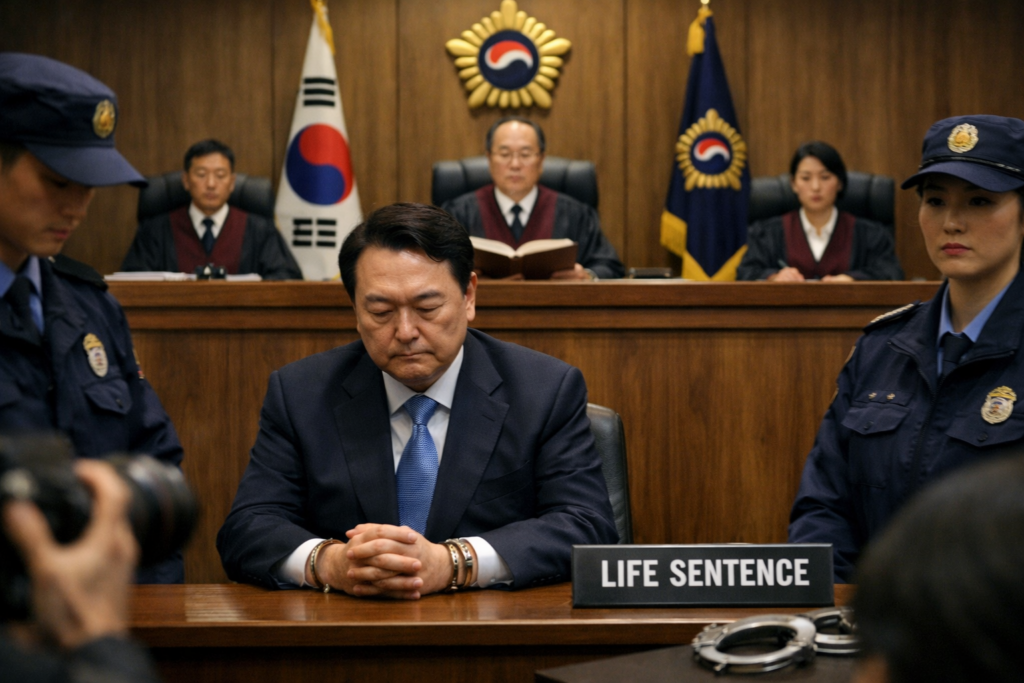
In a landmark decision with global reverberations, a South Korean court has sentenced former president Yoon Suk Yeol to life imprisonment after finding him guilty of leading an insurrection linked to his unprecedented attempt to impose martial law in December 2024 — a move judged to have undermined the nation’s constitutional system.
This verdict marks one of the most significant instances in recent history in which a former head of state has been held fully accountable for actions judged to challenge democratic foundations.
What Led to the Verdict
Yoon Suk Yeol, a conservative leader who rose from a career as a prominent prosecutor to the presidency in 2022, shocked his nation during the final year of his term. On 3 December 2024, as political conflict with parliament escalated, he announced the imposition of martial law — a drastic measure that would have empowered security forces to suspend ordinary democratic functions, including the work of the legislature.
The decree was in response to a legislature controlled by an opposing party that had blocked much of his policy agenda. Yoon framed his actions as necessary to suppress what he called “anti‑state forces,” but critics immediately condemned the move as a constitutional violation.
Within hours, lawmakers broke through a military blockade and unanimously voted to end the emergency rule, sparking mass public debate and triggering impeachment proceedings.
Impeachment and Legal Consequences
Following the failed martial law declaration:
Yoon was impeached by the National Assembly on 14 December 2024.
In April 2025, the Constitutional Court confirmed his removal from office.
He was arrested and indicted on multiple charges linked to his actions.
The rebellion charge, deemed the most severe, ultimately led to Thursday’s life sentence. Prosecutors had initially sought the death penalty, arguing that his actions posed a fundamental threat to democratic stability. However, the court opted for life imprisonment — the harshest available penalty short of execution, which South Korea has not carried out since 1997.
What the Court Determined
The Seoul Central District Court concluded that:
Mobilizing military and police forces to surround the liberal‑led National Assembly was unlawful.
The declaration aimed to paralyze governance and military personnel in a manner consistent with insurrection under South Korean law.
Yoon’s actions damaged the constitutional order and undermined fundamental democratic safeguards.
In sentencing him to life imprisonment, the judge underscored the seriousness of the offense and the need to uphold constitutional norms.
Sentences for Others Involved
The court’s ruling did not focus solely on Yoon. Several high‑ranking officials implicated in enforcing the martial law order received significant prison terms:
Former Defence Minister Kim Yong‑hyun received a 30‑year sentence for his role in planning and implementing the measures.
There are ongoing legal proceedings and appeals pending, but the life sentence against Yoon remains among the most consequential.
Domestic Reaction and Political Impact
Reactions in South Korea were deeply divided:
Supporters of democratic rule praised the decision as a historic affirmation of constitutional accountability.
Some conservative groups rallied in protest, calling the sentence excessive.
International observers noted the trial’s political sensitivity and the broader implications for accountability in democracies where executive power is tested by constitutional limits.
Why This Matters Globally
South Korea is widely regarded as one of Asia’s most robust democracies, having transitioned from decades of authoritarian rule in the late 20th century to a vibrant multiparty system. The life sentence of a former president over actions judged to undermine the constitution marks a rare and powerful affirmation of democratic norms.
For emerging democracies — including those in Africa and beyond — the case offers a cautionary example: even the highest officeholders can be held to account when constitutional boundaries are crossed.
The Road Ahead
Yoon’s legal team has indicated plans to challenge the ruling, and additional criminal charges remain pending against him for other alleged abuses of power.
However, Thursday’s life sentence sets a precedent not just in South Korea, but in how democracies worldwide navigate accountability, executive overreach, and the preservation of constitutional order.